Synod, representation and gender
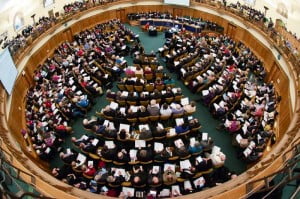 It is with some trepidation that I take offered myself equally a candidate for Full general Synod for the next quinquennium (v-year term), having been a member for Salisbury Diocese in 2000–2005. During that time, nosotros signed off the last stages of liturgical revision (remember that?!) including the ordinal and alternative collects, and received the first-classSome Bug in Human Sexuality, amid other things. Since and so, Synod has had to bargain with some even more demanding (and bruising) issues, not least the two attempts to admit women to the episcopate.
It is articulate that the next session will exist strongly shaped past the 'Reform and Renewal' calendar, and this will bear on issues of church growth, discipleship, and theological education as well equally questions of clergy deployment and the increasing role of lay ministry. And, of course, with the Shared Conversations process coming to an stop, the Church's position on aforementioned-sexual activity spousal relationship will likewise be on the agenda in one form or another.
For that reason, it is worth thinking about the potential make-up of the new Synod—though these things normally have some time to piece of work out. In recent conversation virtually the elections, someone passed to me the analysis they had done on the candidates, and I offer it here along with some further analysis of my own. The table below gives the numbers of men and women standing for clergy and lay elections in each diocese (CM is clergy men, etc), as far as it is possible to discern from diocesan websites, and I accept calculated the number of candidates standing per place for each house (the column C/P):
| Diocese | C K | C Westward | Pl | C/P | 50 M | L W | Pl | C/P |
| Bath and Wells | 9 | ii | 4 | ii.75 | 4 | 5 | v | 1.80 |
| Birmingham | 4 | 3 | three | 2.33 | three | 4 | three | 2.33 |
| Blackburn | 9 | 1 | 5 | 2.00 | 3 | 7 | half-dozen | 1.67 |
| Bristol | 7 | 0 | 3 | ii.33 | seven | 1 | 3 | 2.67 |
| Canterbury | 9 | 1 | 3 | 3.33 | 2 | 3 | iii | 1.67 |
| Carlisle | 5 | i | 3 | 2.00 | 5 | 3 | iv | 2.00 |
| Chelmsford | x | 3 | 7 | 1.86 | 11 | 6 | seven | 2.43 |
| Chester | 4 | 3 | 6 | 1.17 | vii | 4 | 8 | 1.38 |
| Chichester | 13 | 2 | 5 | iii.00 | 11 | 7 | 8 | two.25 |
| Coventry | iii | two | three | one.67 | 4 | 1 | iii | 1.67 |
| Derby | half dozen | two | 3 | ii.67 | 3 | 7 | 3 | three.33 |
| Durham | ix | 1 | 5 | 2.00 | 4 | 3 | 4 | i.75 |
| Ely | half-dozen | 0 | 4 | 1.fifty | 3 | 7 | iii | 3.33 |
| Europe | 6 | one | 3 | ii.33 | 4 | 4 | 3 | ii.67 |
| Exeter | 8 | 1 | iv | 2.25 | 9 | 7 | 4 | 4.00 |
| Gloucester | 4 | 2 | 3 | two.00 | 11 | three | 4 | 3.50 |
| Guildford | 4 | 2 | 4 | 1.fifty | 11 | iii | 4 | three.fifty |
| Hereford | iii | 1 | iii | one.33 | four | 2 | 3 | 2.00 |
| Leicester | 8 | 1 | 3 | 3.00 | three | five | 3 | 2.67 |
| Lichfield | nine | iv | 6 | two.17 | eleven | 11 | 6 | 3.67 |
| Lincoln | seven | 6 | 4 | 3.25 | four | 4 | 4 | 2.00 |
| Liverpool | 3 | 3 | 5 | i.20 | 7 | 3 | 5 | two.00 |
| London | 21 | half dozen | 11 | 2.45 | 23 | 21 | eleven | four.00 |
| Manchester | 8 | 4 | vii | 1.71 | 9 | two | 6 | 1.83 |
| Newcastle | 5 | 4 | 3 | iii.00 | 5 | 3 | 3 | 2.67 |
| Norwich | three | iii | iv | i.fifty | iii | 5 | 3 | 2.67 |
| Oxford | 21 | viii | ix | 3.22 | 13 | 8 | 8 | ii.63 |
| Peterborough | three | i | iii | 1.33 | 4 | 2 | 3 | 2.00 |
| Portsmouth | 6 | 0 | three | ii.00 | 5 | 3 | three | ii.67 |
| Rochester | 6 | 1 | four | 1.75 | 8 | 3 | 5 | 2.20 |
| St Albans | 12 | 4 | 5 | 3.20 | 13 | 2 | 5 | 3.00 |
| St Eds and Ips | seven | 1 | 3 | ii.67 | 5 | v | 3 | iii.33 |
| Salisbury | 7 | one | five | one.threescore | five | four | vi | 1.50 |
| Sheffield | 7 | 1 | 3 | 2.67 | five | 4 | 3 | 3.00 |
| Sodor and Homo | 3 | 0 | 1 | 3.00 | 1 | i | i | ii.00 |
| Southwark | 8 | 5 | 7 | 1.86 | eleven | 8 | 7 | 2.71 |
| South'well and Nottm | half dozen | 0 | three | ii.00 | 8 | 4 | 4 | 3.00 |
| Truro | 4 | 2 | 3 | 2.00 | seven | six | 3 | 4.33 |
| W Yorks & D (Leeds) | 12 | viii | 10 | two.00 | 14 | 5 | nine | two.11 |
| Winchester | viii | 4 | iv | 3.00 | 8 | 5 | 5 | 2.60 |
| Worcester | 6 | iii | 3 | iii.00 | iv | iii | 3 | 2.33 |
| York | 3 | four | 5 | 1.40 | 5 | 5 | 6 | 1.67 |
| Full | 302 | 102 | 185 | 2.27 | 287 | 199 | 193 | two.52 |
If there are any mistakes here you spot from your own diocese, or you can fill in the gaps, please postal service in the comments below.
There are a few interesting things to annotation:
- As you can encounter from the C/P average, the competition for clergy places overall (2.27 candidates per place) is slightly less than the competition for lay places (at ii.46)—which I think is fairly usual. What this masks, though, is that yous have to exist a particular kind of person to be a lay member of Synod; whereas clergy tin can count it as 'work' fourth dimension, every bit a lay member you accept to be able to take the time out since there is no recompense for lost earnings. You therefore need to be wealthy, cocky-employed, retired, highly committed, or a combination of all four. This is countered by the fact that there is no retirement historic period for lay members as there is for clergy—though there might be force per unit area to change this, with the increasing number of retired clergy who are active in ministry.
- There is considerable variation in competition between different dioceses. For clergy, your best hazard of being elected is in Chester, Liverpool or Peterborough, where merely one person volition not succeed. In the new diocese of Leeds, there are not sufficient lay candidates to make full the places. On the other manus, Canterbury, Oxford and St Alban'due south are hotly contested among the clergy, where fewer than one in three candidates will be elected, and at that place is also serious competition for lay places in several dioceses.
- The full number of members of Synod was reduced afterward my quinquennium, and these figures take been further revised for this election. This has left a good number of medium-sized dioceses with three proctors (clergy to be elected), and in almost dioceses ane of these is taken past an archdeacon, since the balloter 'higher' of archdeacons was abolished when numbers were reduced. The net result of this is to (in effect) eliminate minority views under the STV arrangement; if candidates property a minority view come up third amidst the non-archdeacons across all dioceses, then they volition disappear from all only the larger dioceses. If, on the other manus, either dioceses or their Synod representation were merged, then such candidates would reappear over again in the longer listing that would result. In other words, 2 lists of 3 look much more homogeneous and so one list of six, and this will be increasingly felt if Synod becomes whatever smaller. (A similar dynamic applies to contested mid-term elections; they outcome in appointing more than of the same.)
Simply perhaps the almost hitting matter near these numbers is the low representation of women, peculiarly for the House of Clergy.
In that location are almost three times every bit many men continuing as women (299 to 99),
and five dioceses accept no women continuing at all.
(Bristol, Ely, Portsmouth, Sodor and Human, and Southwell and Nottingham)
It is not difficult to think of some reasons for this. There are a good number of jobs in the C of E that involve quite a bit of boring admin, and in among the important debates, there is a lot of slow admin involved in being on Synod. (For a theological evaluation of much of this irksome admin, I would refer you to Phil iii.8b.) My universal experience is that women are more sensible than men in avoiding this wearisome admin! More broadly, a higher proportion of ordained women are in part-fourth dimension or split-role ministries, and adding Synod membership into this mix is more challenging than if yous are in a single, full-time, stipendiary role. There is a particular upshot of timing also; many women will have stood for the last Synod considering of the outcome of women bishops, and a good number of them probably feel as though they have washed their time and take the bruises to bear witness for it—now is a skillful time to pace down.
Any the reasons, will information technology make a departure? Given the decisions fabricated over the last 10 years, I am not certain that at that place are major concerns about directly representation on bug that bear upon women in ministry or in church membership (though I am happy to exist corrected on this). But my other universal experience is that women bring something distinctive to the kinds of processes that Synod makes use of, and if the side by side Synod is more male-dominated, I am non sure that that is going to be a particularly practiced thing. It remains to be seen whether this will exist the example; where in that location are few women candidates, they are more probable to be elected, then the imbalance of candidates will not translate into the aforementioned imbalance of Synod members.
Either which manner, i affair is clear: if we want more equal gender representation in Church government, we cannot leave it to chance.
Follow me on Twitter @psephizo
Much of my work is done on a freelance footing. If y'all have valued this post, would y'all consideraltruistic £one.20 a month to support the product of this blog?
If you enjoyed this, exercise share information technology on social media (Facebook or Twitter) using the buttons on the left. Follow me on Twitter @psephizo. Like my folio on Facebook.
Much of my work is washed on a freelance ground. If y'all accept valued this post, y'all can make a unmarried or repeat donation through PayPal:
Comments policy: Proficient comments that engage with the content of the post, and share in respectful debate, can add real value. Seek first to empathize, then to be understood. Make the near charitable construal of the views of others and seek to learn from their perspectives. Don't view debate every bit a conflict to win; accost the statement rather than tackling the person.
Source: https://www.psephizo.com/life-ministry/synod-representation-and-gender/
0 Response to "Synod, representation and gender"
Yorum Gönder